Wood Look Tile vs Vinyl Plank: What Lehigh Acres Homeowners on Slabs Need to Know
Walk into almost any home showroom in Southwest Florida right now and two products dominate the flooring conversation: wood look porcelain tile and luxury vinyl plank. Both mimic the warmth of hardwood. Both come in dozens of realistic finishes. But once you factor in the actual conditions inside a Lehigh Acres home on a concrete slab, the comparison shifts pretty quickly toward one clear front-runner.
We see this decision come up constantly when homeowners call us about flooring. The short answer is that tile almost always performs better in this specific environment, and the reasons go deeper than people expect. Here is how the two products actually stack up when you put them against the realities of ground-floor Florida living.
Why Slab Moisture Changes Everything
Most homes in Lehigh Acres sit directly on a concrete slab with no crawlspace underneath. That matters a lot for flooring because concrete is never fully dry. Even well-cured slabs transmit moisture vapor, especially in our humid Southwest Florida summers when the ground stays saturated for months at a stretch. That vapor moves upward through the slab constantly.
Porcelain tile is virtually impermeable to moisture. It does not absorb, swell or delaminate from vapor transmission. Vinyl plank, on the other hand, is sensitive to what happens at the slab surface. Excess moisture vapor pressure can push up from below, breaking the adhesive bond or causing planks to cup, buckle or release at the seams. Most manufacturers require a moisture test before installation and specify maximum emission limits. In a Florida climate, failing that test is not unusual, particularly in older homes or in areas where the slab sits close to grade.
This is not a knock on vinyl plank as a product. It performs well in the right conditions. But on a warm Florida slab with active vapor drive, you are working against the material rather than with it.
Flooding and Storm Surge Resilience
Hurricane season is a real planning factor for any Lehigh Acres homeowner. Flooding from heavy rain events, storm surge or even a broken appliance can saturate an interior floor quickly. How the floor recovers afterward matters.
Porcelain tile handles standing water without degrading. Once the water is removed and the space dries out, the tile itself is unchanged. The grout joints may need attention depending on how long water sat, but the tile is intact. Vinyl plank is more complicated. Quality LVP products are waterproof on their surface, but extended submersion can allow water to wick under the planks from the edges and seams. Once moisture gets trapped beneath the planks, mold and adhesion problems can develop quickly in Florida's heat.
For ground-floor rooms, especially in areas that have seen flooding before, tile gives you a floor that stands up to the worst Southwest Florida weather can deliver.
Pets, Heavy Traffic and Long-Term Wear
A lot of Lehigh Acres families have large dogs. Claws, scratching and general animal traffic are hard on many floor surfaces over time. Vinyl plank, even high-end products with thick wear layers, will eventually show scratches and scuffs from pet nails. The texture and finish can dull in high-traffic paths over years of use.
Porcelain tile is one of the hardest floor surfaces available. The glaze layer on a quality wood look tile is rated for heavy residential and even light commercial use. Pet nails do not scratch it. Furniture legs do not dent it. The color and texture are baked into the surface at extremely high temperatures during manufacturing, so the finish does not wear away from foot traffic the way softer materials do.
If you have kids, pets and an active household, tile is the floor that will look the same in fifteen years that it does on day one.
How Wood Look Tile Has Changed
One reason this comparison even exists is that wood look tile was not always convincing. A decade ago, most of it looked obviously fake. The plank sizes were small, the wood grain was repetitive and the color palette was limited.
That has changed significantly. Today's large-format wood look porcelain tiles come in plank sizes up to 8 by 48 inches with digital printing technology that replicates grain variation, knots, mineral streaks and surface texture at a level that is genuinely difficult to distinguish from real wood at a glance. Rectified edges allow for tighter grout joints that further reduce the visual break from plank to plank. Matte finishes have replaced the older glossy look that gave tile away immediately.
If the concern about choosing tile over vinyl has been purely about appearance, the current generation of wood look porcelain addresses most of that. Our tile installation work in Lehigh Acres regularly uses these formats in living rooms, master bedrooms and open-plan kitchen areas where homeowners were initially set on vinyl plank.
Installation Differences That Matter on a Slab
Vinyl plank is often marketed as a floating floor that can be installed directly over an existing surface. That makes it appealing as a DIY project or a quick renovation. But floating floors on slabs can amplify hollow spots, feel slightly springy underfoot and transmit noise between rooms more than a fully bonded floor.
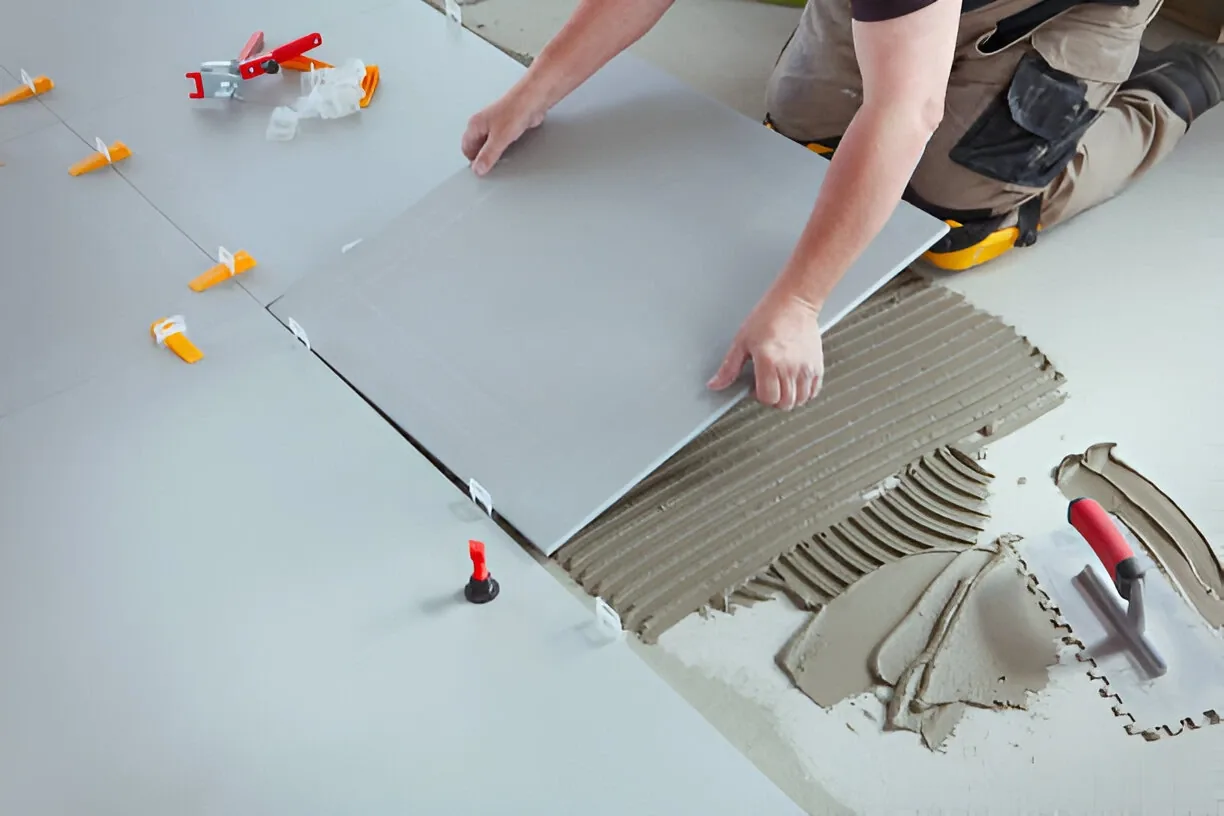
Tile requires more involved installation: the slab must be flat within industry tolerance (typically no more than 3/16 inch variation over 10 feet), properly primed or treated for adhesion, and the tile set with a quality thin-set mortar. That process takes more time and skill, but the result is a floor that is mechanically bonded to the slab. There is no movement, no hollow sound and no flex.
Proper slab prep also gives a tile installer the opportunity to address any existing issues before covering them. We regularly find minor cracks, high spots or contamination during prep that would have caused problems for any floor covering if left unaddressed. For rooms adjacent to a bathroom remodel in Lehigh Acres or a wet area, that preparation step is especially important.
Maintenance Over Time
Both products are relatively low maintenance compared to natural hardwood. But they age differently.
Vinyl plank can be difficult to repair. If a plank is damaged, matching the color and texture of an older floor from a discontinued product line is often impossible, meaning partial replacements look patchy. The surface finish also degrades gradually with heavy use, and there is no way to refinish it.
Tile can be repaired tile-by-tile if you keep a few spare pieces from the original run. Grout can be recolored or replaced without touching the tile itself. And because the surface does not wear in any meaningful way under normal residential conditions, the floor looks consistent for decades. For a kitchen remodel in Lehigh Acres, where floors take constant traffic, spills and chair dragging, that long-term durability is a significant advantage.
The Bottom Line
For ground-floor rooms in Lehigh Acres homes on concrete slabs, wood look porcelain tile consistently outperforms vinyl plank in the conditions that matter most here: slab moisture vapor, flooding risk, pet traffic and long-term wear. Vinyl plank has its place, particularly in upper-level applications where slab vapor is not a factor, but for the typical Southwest Florida ground-floor installation it is working against the environment rather than with it.
If you are weighing this decision for an upcoming project, Dynasty Tile has been serving Lehigh Acres and the broader Southwest Florida area as a licensed tile contractor since 2016. We offer free, no-obligation estimates and can walk you through current wood look tile options in person. Call us at (239) 265-2814 to get started.